A domed neoclassical building full of Old Masters, a glass-and-granite modern wing full of Calder and Rothko, and the only Leonardo da Vinci painting on public view anywhere in the Americas — all free, on the National Mall.
The collection splits across two very different buildings — John Russell Pope's domed West Building and I.M. Pei's geometric East Building — joined by an underground concourse, with no single route obligated between them. Wall labels are thorough but easy to lose track of in a crowded gallery, and a phone search for 'that portrait with the mirror in the National Gallery' rarely surfaces the right room, let alone the right century.
ELYIO turns the camera already in your pocket into a quiet second opinion. Point it at a canvas, a sculpture, or a mobile suspended overhead, and the app tries to identify what it can — artist, title, era — so the next stop is a painting you chose, not a number on a printed map.
What to see
Old Masters live in one building, modern and contemporary art in the other, and a garden of monumental sculpture sits between them. These four areas are where most visits naturally take shape.
The West Building Rotunda & Old Masters
John Russell Pope's domed rotunda, modeled on Rome's Pantheon, anchors galleries of European painting from the medieval period through the 19th century — Vermeer, Rembrandt, Titian, and the room holding the gallery's single Leonardo.
American Art Galleries
Colonial portraiture through 19th-century American painting, including Gilbert Stuart's likenesses of the young republic, in rooms that trace a distinctly American visual history alongside the European collection.
The East Building
I.M. Pei's angular modern wing, built around a soaring atrium hung with Alexander Calder's largest mobile, holds the 20th-century collection — Picasso, Matisse, Rothko, Pollock — in a building that is itself worth the visit.
The Sculpture Garden
A 6-acre outdoor gallery across 7th Street, built around a circular reflecting pool that becomes a skating rink in winter, showing monumental works by Miró, Lichtenstein, and Louise Bourgeois in the open air.
Masterpiece stories
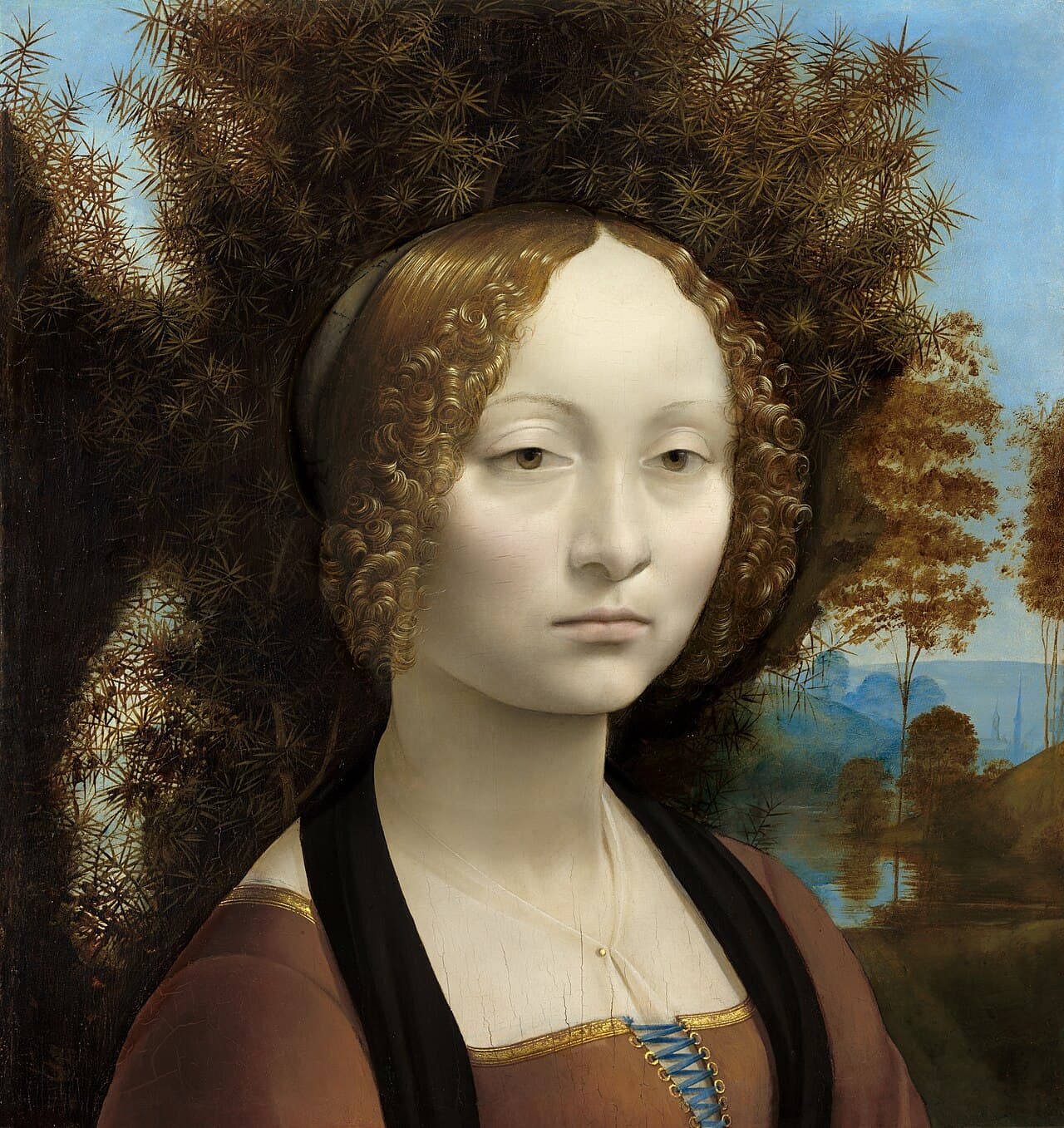
Leonardo da Vinci · c. 1474–1478
Ginevra de' Benci
The only painting by Leonardo da Vinci on public view anywhere in the Americas — a young Florentine woman staring past the viewer with an expression that refuses to soften.
Painted in Florence, likely to mark Ginevra de' Benci's betrothal, the portrait was acquired by the Gallery in 1967 from the Princely House of Liechtenstein for a then-record price for a painting. A juniper bush fills the background as a play on her name — ginepro is Italian for juniper — and the reverse of the panel carries a Latin motto: Beauty adorns virtue.
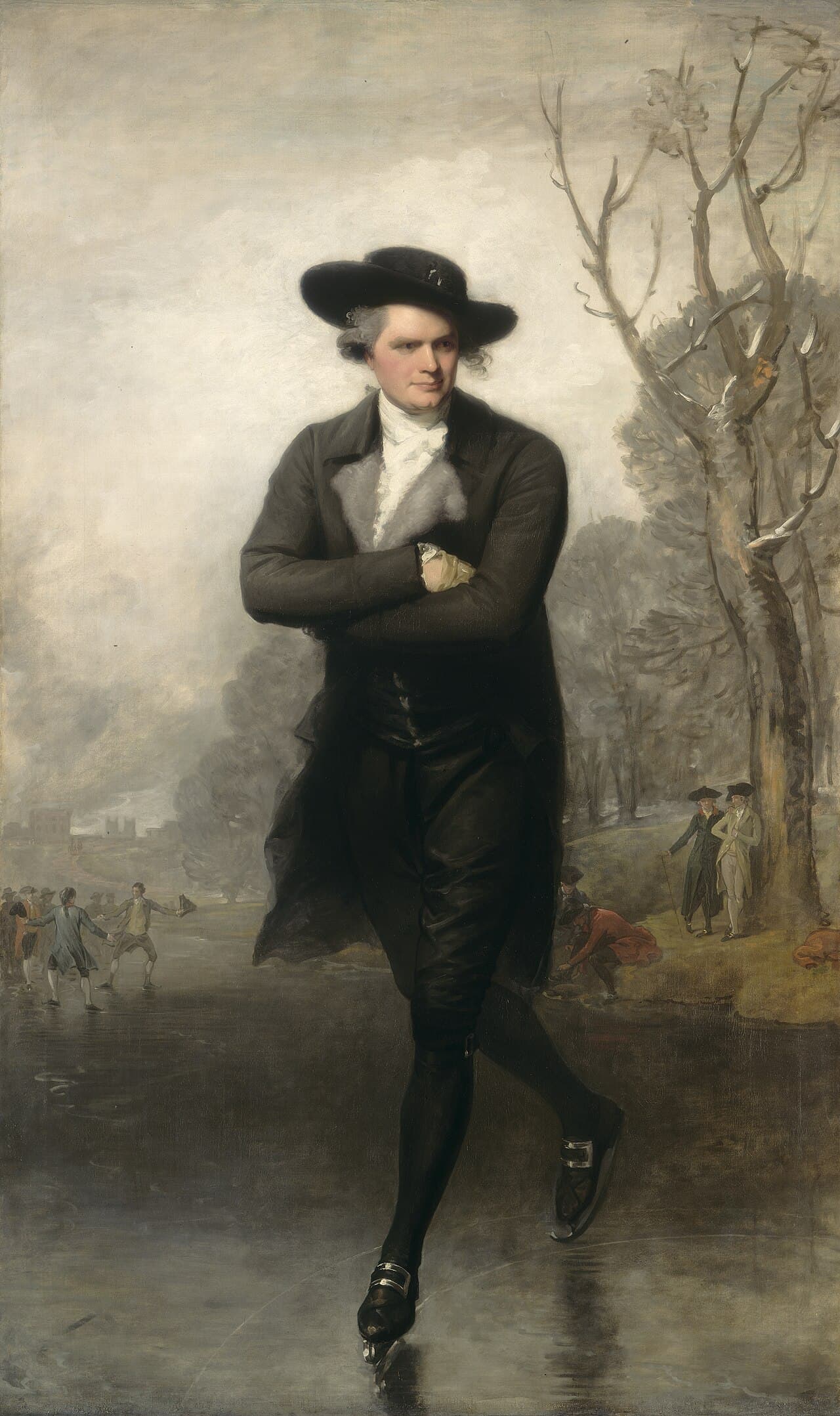
Gilbert Stuart · 1782
The Skater (Portrait of William Grant)
A full-length portrait that breaks every rule of formal portraiture by putting its subject on ice skates, gliding across a frozen London park.
Stuart painted the young Scottish merchant William Grant not standing still but in motion, arms folded, mid-glide on the Serpentine — a composition so unconventional for its time that it made Stuart's reputation almost overnight.
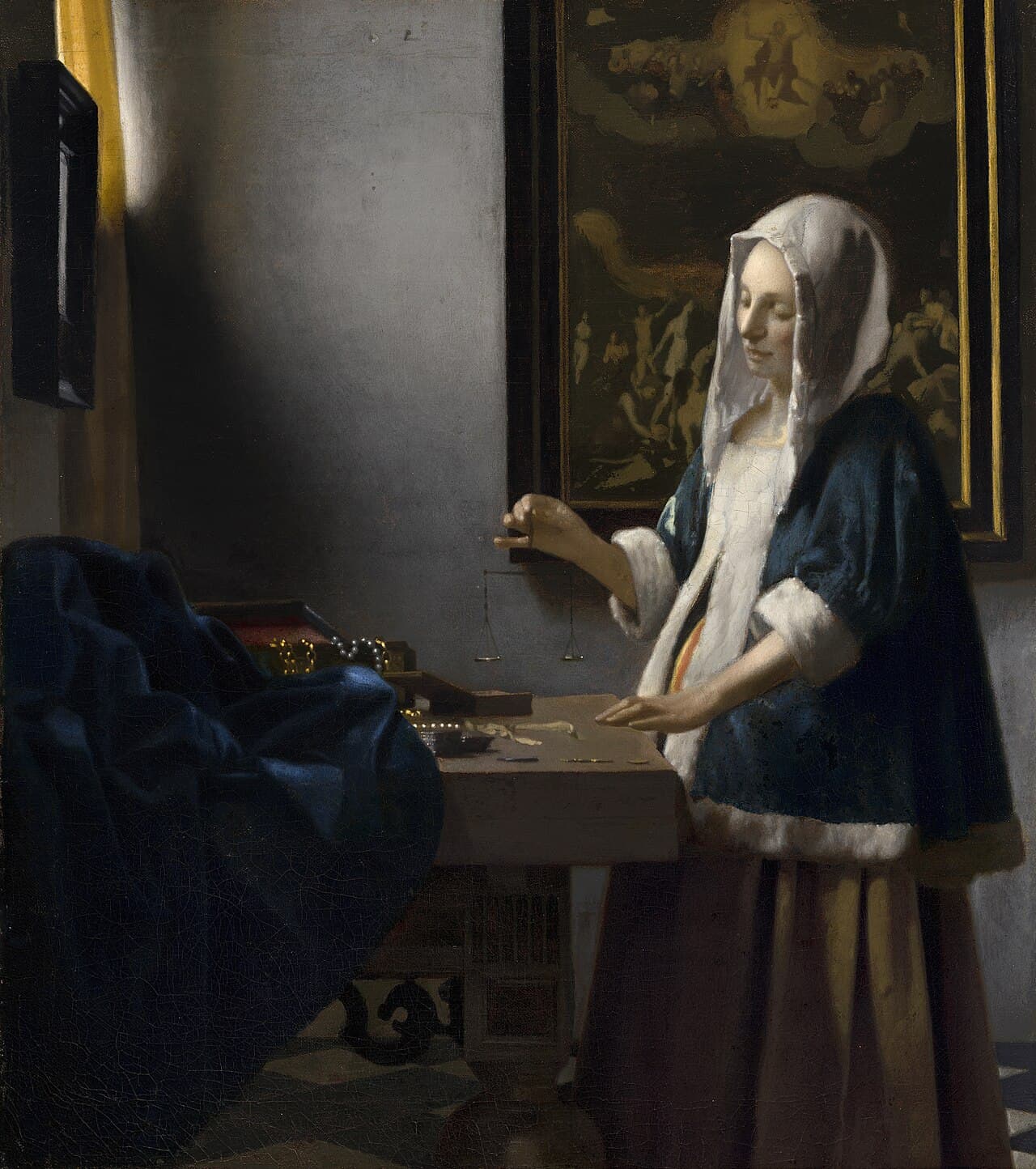
Johannes Vermeer · c. 1662–1663
Woman Holding a Balance
A woman weighs something in a scale that, on close inspection, holds nothing at all — light falling through a curtained window onto a moment suspended between judgment and vanity.
One of roughly three dozen paintings confidently attributed to Vermeer, this small interior has been read for centuries as an allegory of moral weighing, its empty scale pan turning a domestic scene into a meditation on balance and restraint.
How to explore with ELYIO
There's no required order between the two buildings, and no shame in skipping one entirely on a given visit. Many people pick a century or a building by instinct — Old Masters and marble, or Calder and glass — and let one room lead naturally into the next.
Self-guided visits
Bring ELYIO instead of a printed floor plan. Lift your phone toward whatever's stopped you — a portrait, a mobile, a sculpture in the garden — and let the recognition fill in what it can, without requiring you to hunt down the nearest wall label first.
Traditional audio guide vs. ELYIO
Traditional audio guide
Cross-reference a printed map to figure out which building, and which floor, holds what you're looking for
Wait for a break in the crowd to read a small wall label, then forget the name five rooms later
Leave with photos of dozens of works and the names of only a handful
With ELYIO
Point your camera at a painting, a mobile, or a garden sculpture and get an identification on the spot
Ask a follow-up question about the artist or period in plain language
Move freely between the West and East Buildings — ELYIO adapts to whatever stops you next
The National Gallery of Art sits on the National Mall between 3rd and 9th Streets at Constitution Avenue NW. Admission has been free since the Gallery was established for the American people in 1937 — one of the very few major art museums anywhere to make free entry a founding condition rather than a promotion. The West and East Buildings are linked by an underground concourse (home to Leo Villareal's light installation Multiverse), so a single visit can move between both without going back outside. The Gallery is not part of the Smithsonian Institution, despite standing on the Mall alongside it. Because ELYIO's recognition for this museum is still in controlled preview, treat it as a companion for what it can identify today, not a replacement for the Gallery's own wall texts and guides.
Frequently asked questions
Is the National Gallery of Art free to enter?
Yes. Admission to both the West and East Buildings has been free since the Gallery was established by Congress in 1937 — it remains free today, with no general admission ticket required.
Is Ginevra de' Benci really the only Leonardo da Vinci painting in the Americas?
Yes. Leonardo's Ginevra de' Benci, acquired by the Gallery in 1967, is the only painting confidently attributed to him on public display anywhere in North or South America.
Does ELYIO recognize everything in the National Gallery's collection?
Not yet. ELYIO's recognition for this museum is in controlled preview, so point your camera at what catches your eye and the app will identify what it currently can — coverage is expanding over time, not complete from day one.
Is ELYIO affiliated with or endorsed by the National Gallery of Art?
No. ELYIO is an independent camera-recognition app and is not partnered with, endorsed by, or operated on behalf of the National Gallery of Art.
Do I need to visit the West Building and East Building in a specific order?
No. ELYIO isn't built around a fixed tour route, and neither is the museum — the two buildings are connected but independently explorable, in whatever order and however much time you give each one.