Ceramics, couture, carpets, and casts — 5,000 years of applied art and design under one Kensington roof, from a Safavid carpet to a sultan's mechanical tiger.
The V&A holds roughly 2.8 million objects across 145 galleries — more department store of world craft than single museum, with fashion beside ironwork beside a 500-year-old carpet. A wall label can tell you what a thing is; it rarely tells you why a Safavid weaver signed a couplet into a carpet's border, or why a mechanical tiger ended up in a reading room in the City of London.
ELYIO turns the phone in your pocket into a quiet second opinion for objects, not just paintings. Point it at whatever's stopped you — a textile, a ceramic glaze, a piece of furniture — and the app tries to identify what it can, so the object explains itself before you've found the right case label.
What to see
There's no single route through a museum this size, and no need for one — visitors tend to gravitate toward fashion, or ceramics, or the sheer scale of the Cast Courts, and let curiosity do the routing from there.
The Cast Courts
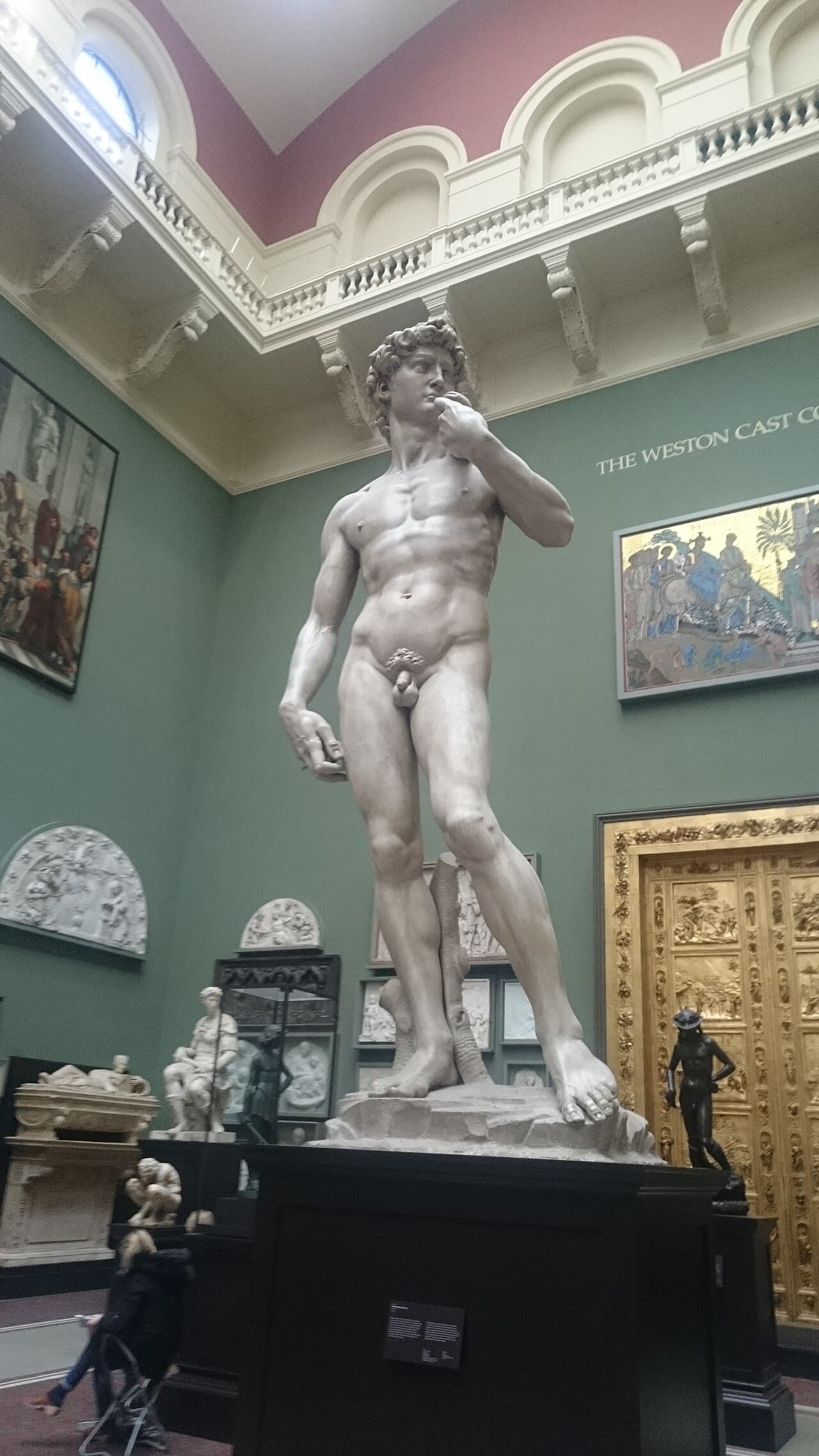
Two soaring Victorian halls built to hold plaster casts of European sculpture and architecture at full scale, including a cast of Michelangelo's David and a section of Trajan's Column too tall for the room it stands in.
Fashion
Corsetry, court dress, and catwalk pieces trace two centuries of how clothes have been cut, worn, and argued about, with rotating displays that put historic silhouettes next to contemporary design.
The Jameel Gallery of Islamic Art
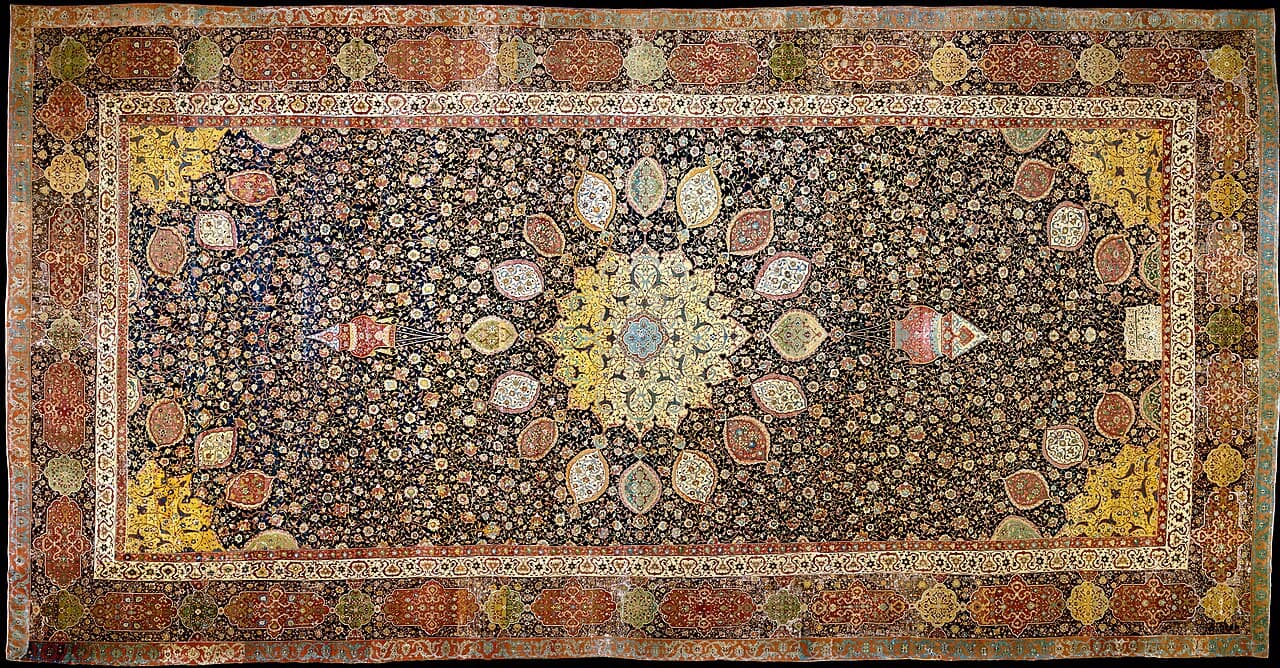
Ceramics, metalwork, and calligraphy from the Islamic world surround the gallery's centrepiece, the Ardabil Carpet, kept under low light in a case built specifically to hold it flat.
Ceramics, Glass, and Metalwork
Floor after floor of the applied arts the museum was founded to champion, from Wedgwood and Meissen porcelain to studio glass and English silver, arranged for close, unhurried looking.
Masterpiece stories
Maqsud of Kashan (attributed) · 1539–40
The Ardabil Carpet
A silk-founded wool carpet with roughly 26 million knots, signed in a cartouche with a line of Persian poetry and a date — the earliest carpet in the world known to carry one.
Bought for the museum in 1893 with public subscription money raised partly at the urging of William Morris, who called it without equal; it's shown flat, under deliberately low light, to slow its fading.
Photograph: Victoria and Albert Museum, via Wikimedia Commons (CC BY-SA 3.0)
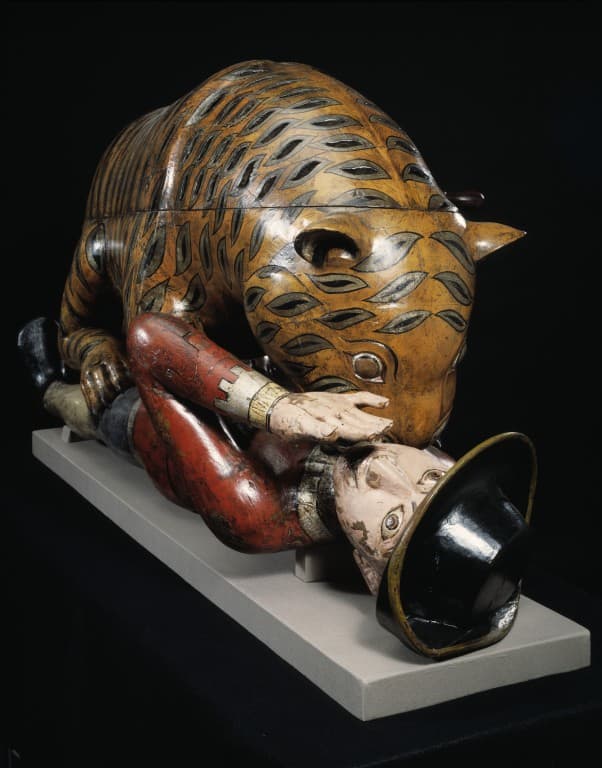
Mysore court workshop, for Tipu Sultan · c. 1795
Tipu's Tiger
Turn a hidden crank and, once, this life-size wooden tiger would grunt through organ pipes while the European soldier beneath it wailed and raised an arm — a sultan's mechanical revenge, decades before it became a museum piece.
Taken from Tipu Sultan's palace after his defeat in 1799 and displayed for decades in the East India Company's own museum before arriving at the V&A in 1880; the crank has long since been retired.
Photograph: VirtuallyLondonBecky, via Wikimedia Commons (CC BY-SA 4.0)
After Michelangelo · Cast 1857 (original 1501–04)
The Cast of Michelangelo's David
A full-size plaster David, so undressed that a fig leaf was reportedly kept in reserve for royal visits — one of hundreds of casts assembled so students could study sculpture they'd never travel to see.
Standing in the purpose-built Cast Courts alongside a cast of Trajan's Column sliced in two to fit under the roof, it's a monument to a 19th-century idea: that a copy, well made, could still teach.
Raphael · c. 1515–16
The Raphael Cartoons
Full-size painted designs for tapestries destined for the Sistine Chapel, on loan from the Royal Collection since the 19th century — cartoons in the original sense, not the comic one.
Shown in their own dedicated gallery, they're some of the largest and most closely studied works on paper — technically watercolour and gouache on paper mounted on canvas — to survive from the Italian Renaissance.
How to explore with ELYIO
Skip the idea of a numbered tour. Most visitors pick a subject that already interests them — fashion, ceramics, ironwork, carpets — and let one gallery lead into its neighbour, since the museum was arranged by material and craft rather than by any single chronology.
Self-guided visits
Bring ELYIO instead of a printed map. Point your phone at whatever object has actually stopped you — a glaze, a weave, a hinge — and let the recognition fill in what it can, since V&A coverage in ELYIO is still expanding rather than complete.
Traditional audio guide vs. ELYIO
Traditional audio guide
Reading a small label about a textile technique while trying not to block the case for other visitors
Trying to remember which gallery had 'that carved bed' well after you've left the building
Following a printed leaflet that assumes you care about the same six objects everyone else does
With ELYIO
Point your camera at the object in front of you and get an identification on the spot
Ask a follow-up question about the material, period, or maker in plain language
Wander by material or mood — ceramics one hour, fashion the next — and let ELYIO keep up
The V&A's main site sits on Cromwell Road in South Kensington, alongside the Natural History Museum and Science Museum, a short walk from South Kensington Underground station. As with other UK national museums, general admission to the permanent collection is free, though the museum is genuinely vast — 145 galleries — so most visitors choose a handful of departments rather than attempt all of them in one visit. ELYIO is an independent app and is not affiliated with or endorsed by the V&A; its recognition for this museum is still in controlled preview, so treat it as a companion for the objects it can currently identify, not a replacement for the museum's own labels and curators.
Frequently asked questions
Is the Victoria and Albert Museum free to enter?
Yes — general admission to the permanent collection is free, in line with other UK national museums. Some special exhibitions are ticketed separately.
Where is the Ardabil Carpet displayed?
It's the centrepiece of the Jameel Gallery of Islamic Art, shown flat under low, carefully controlled lighting to protect its colours.
What are the Cast Courts?
Two large Victorian galleries built to hold full-scale plaster casts of European sculpture and architecture, including a cast of Michelangelo's David and a section of Trajan's Column.
Is ELYIO officially affiliated with the V&A?
No. ELYIO is an independent app that uses AI to help identify objects through your camera; it has no partnership with or endorsement from the museum.
Does ELYIO recognize every object in the V&A's collection?
Not yet, and it's unlikely to ever claim to given the collection's size — around 2.8 million objects. Recognition for this museum is in controlled preview, so point your camera at what interests you and the app will identify what it currently can, with coverage expanding over time.