Inside a Belle Époque train shed on the Left Bank, the Musée d'Orsay holds the world's largest gathering of Impressionist and Post-Impressionist painting. Point your camera at a curated selection of its works and ELYIO tells you what you're looking at, instantly.
The collection unfolds across three levels that aren't arranged in a straight chronological line, so it's easy to walk past a masterpiece without realizing what it is.
Wall labels are brief and often only in French, and the paintings everyone came to see — Olympia, the Van Goghs — are usually ringed by a crowd three or four people deep.
What to see
Before the paintings, the building itself is worth reading. Orsay was the Gare d'Orsay, a Beaux-Arts railway terminus raised in 1900 for the World's Fair, and its bones — iron trusswork disguised behind stone, a coffered glass roof, a single soaring nave — still shape how the art is seen today.
La Nef — the Grand Nave
The old train shed's central hall, lit by its original glass vault, is now lined with 19th-century sculpture. Walk its full length once just to feel the scale of the station Van Gogh's contemporaries would have arrived through.
The Station Clock
One giant gilded clock face survives from the Gare d'Orsay, framing the Seine, the Tuileries and the Louvre beyond it. It's the museum's most photographed vantage point, and a reminder of what this building used to be.
The upper-level Impressionist galleries
Under skylights near the top of the nave, rooms devoted to Monet, Renoir, Degas, Cézanne and Van Gogh hold the works most visitors come for — painted, in many cases, within a few streets of each other in Montmartre.
Post-Impressionist and Pointillist rooms
Beyond the Impressionists proper: Gauguin's Tahiti canvases, Seurat's dot-built compositions, Toulouse-Lautrec's cabaret scenes and early Symbolist painting — the movements Impressionism set in motion.
Masterpiece stories
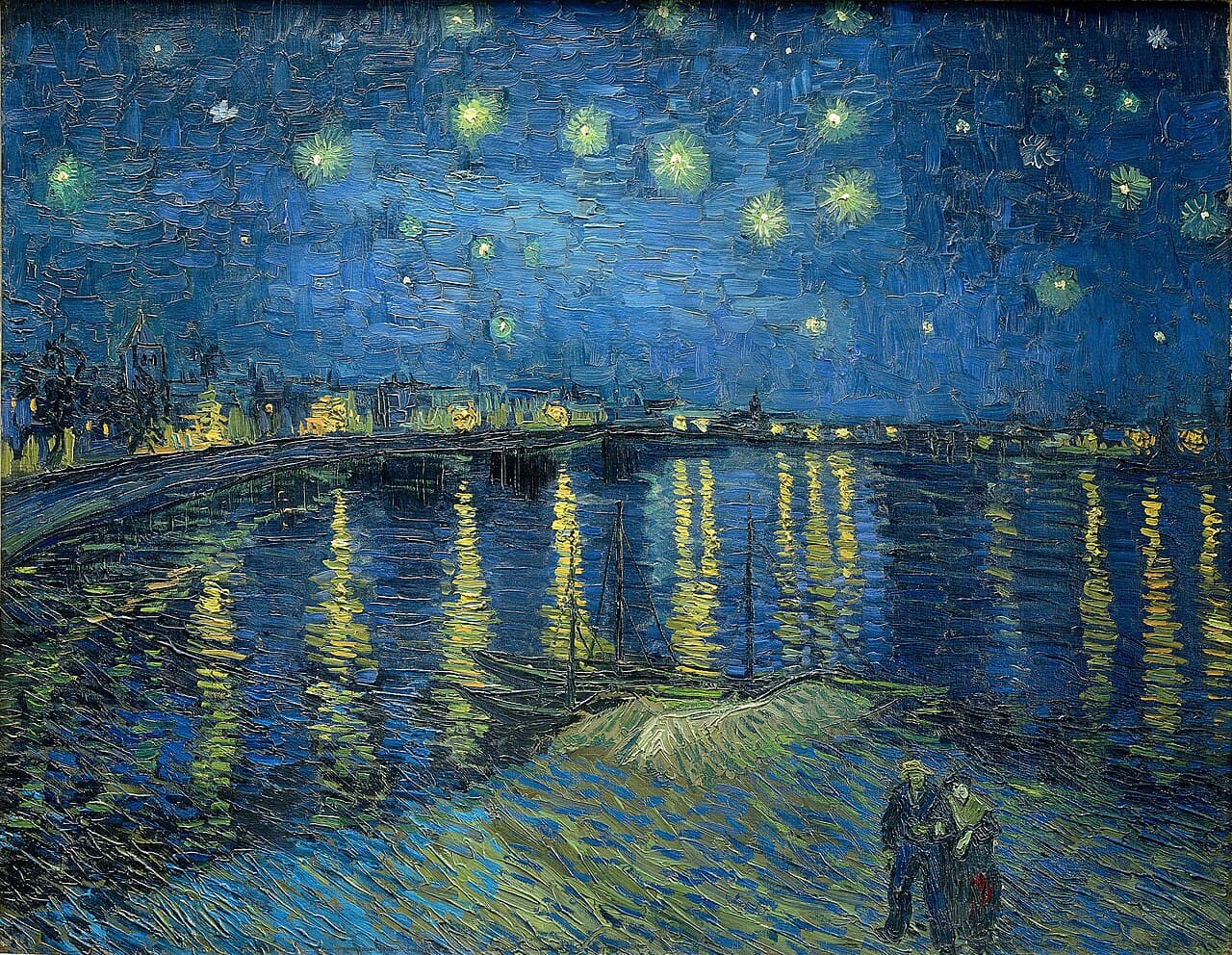
Vincent van Gogh · 1888
Starry Night Over the Rhône
Van Gogh set up his easel on the riverbank at Arles at night to paint gaslight instead of sunlight — years before his more famous Starry Night, and painted from life, not memory.
This is one of van Gogh's first attempts at a night scene, made under actual gas lamps rather than in the studio. The Rhône's gaslit shimmer and the Plough overhead show his early experiments with color used to carry emotion rather than simply describe a view.
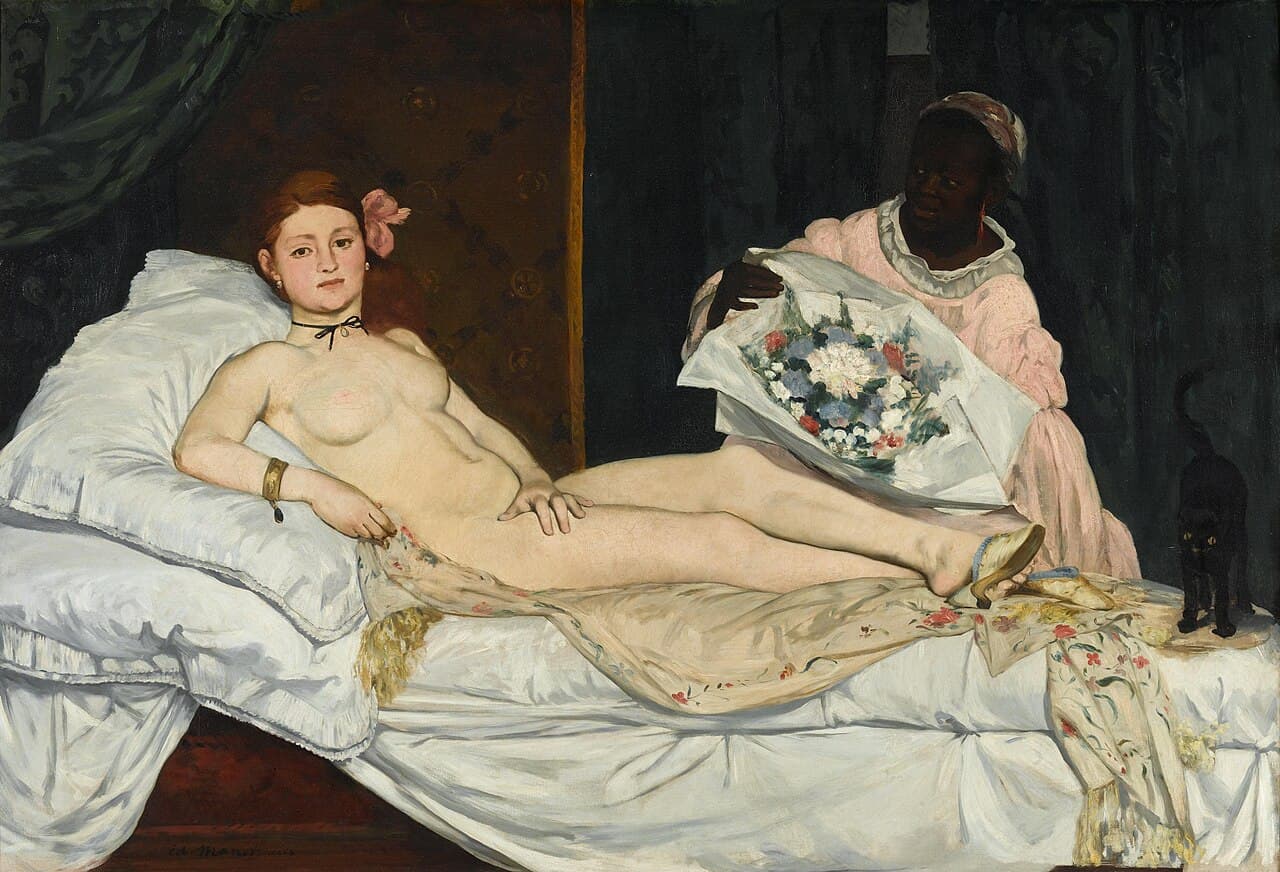
Édouard Manet · 1863
Olympia
A reclining nude who stares straight back at the viewer instead of looking away — a small shift that scandalized Paris and is now read as one of the starting points of modern art.
Manet borrowed the pose of Titian's Venus of Urbino but replaced the goddess with a contemporary Parisian courtesan, gazing at the viewer with unapologetic directness. Shown at the 1865 Salon, it provoked such outrage that guards reportedly had to protect the canvas from the crowd.
Photograph: Sukkoria, via Wikimedia Commons (CC BY-SA 4.0)
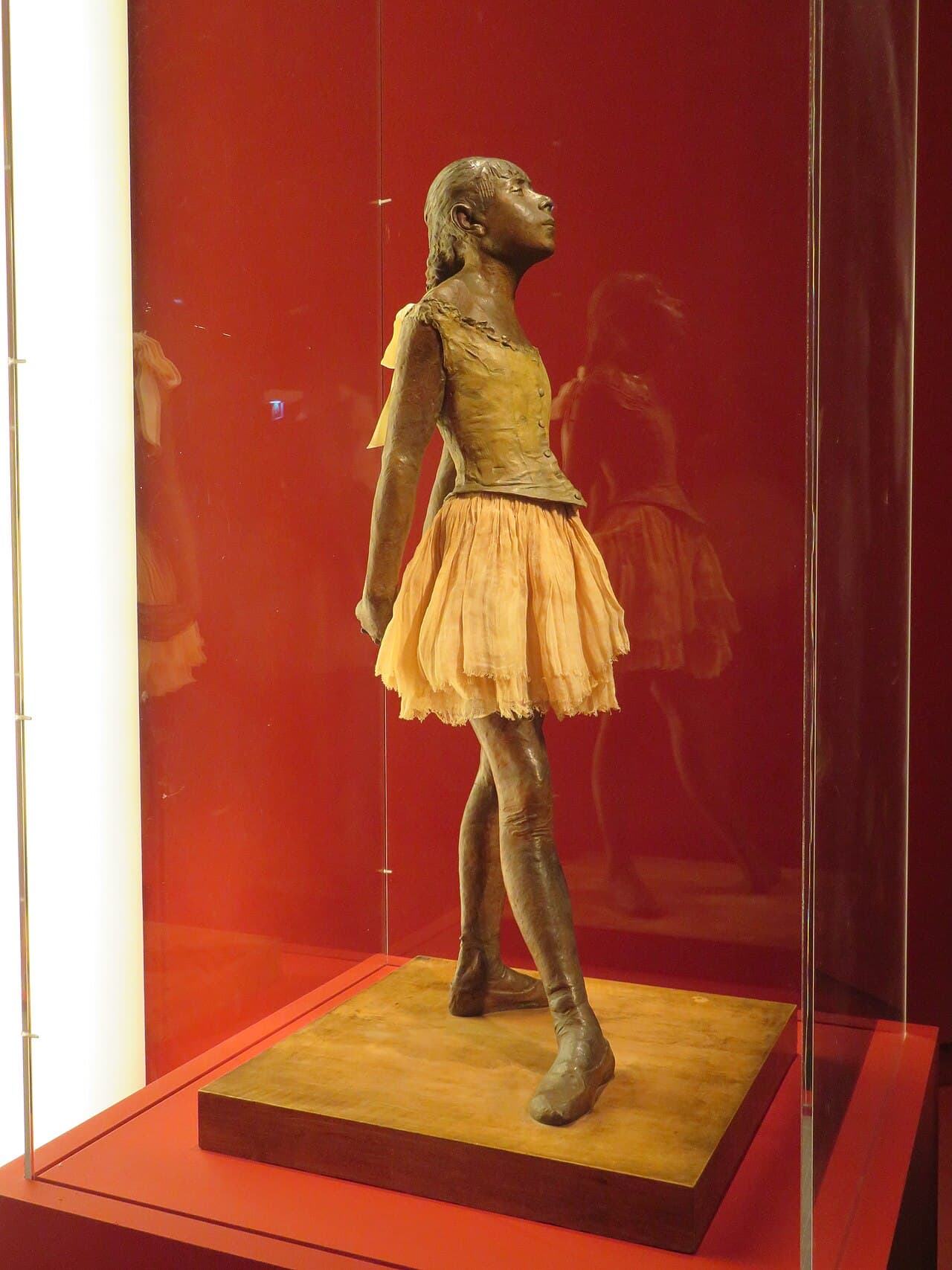
Edgar Degas · 1880 (wax original); posthumous bronze cast
Little Dancer of Fourteen Years (Petite danseuse de quatorze ans)
The only sculpture Degas ever showed to the public in his lifetime — a working ballet student caught mid-pose, dressed in a real fabric tutu instead of sculpted drapery.
Degas modeled the wax original from a young student at the Paris Opera ballet school and exhibited it just once, in 1881, to a mixed and uneasy reception. This bronze is one of the posthumous casts made from his studio molds after his death, finished with a cloth tutu and satin hair ribbon that still make it feel startlingly modern.
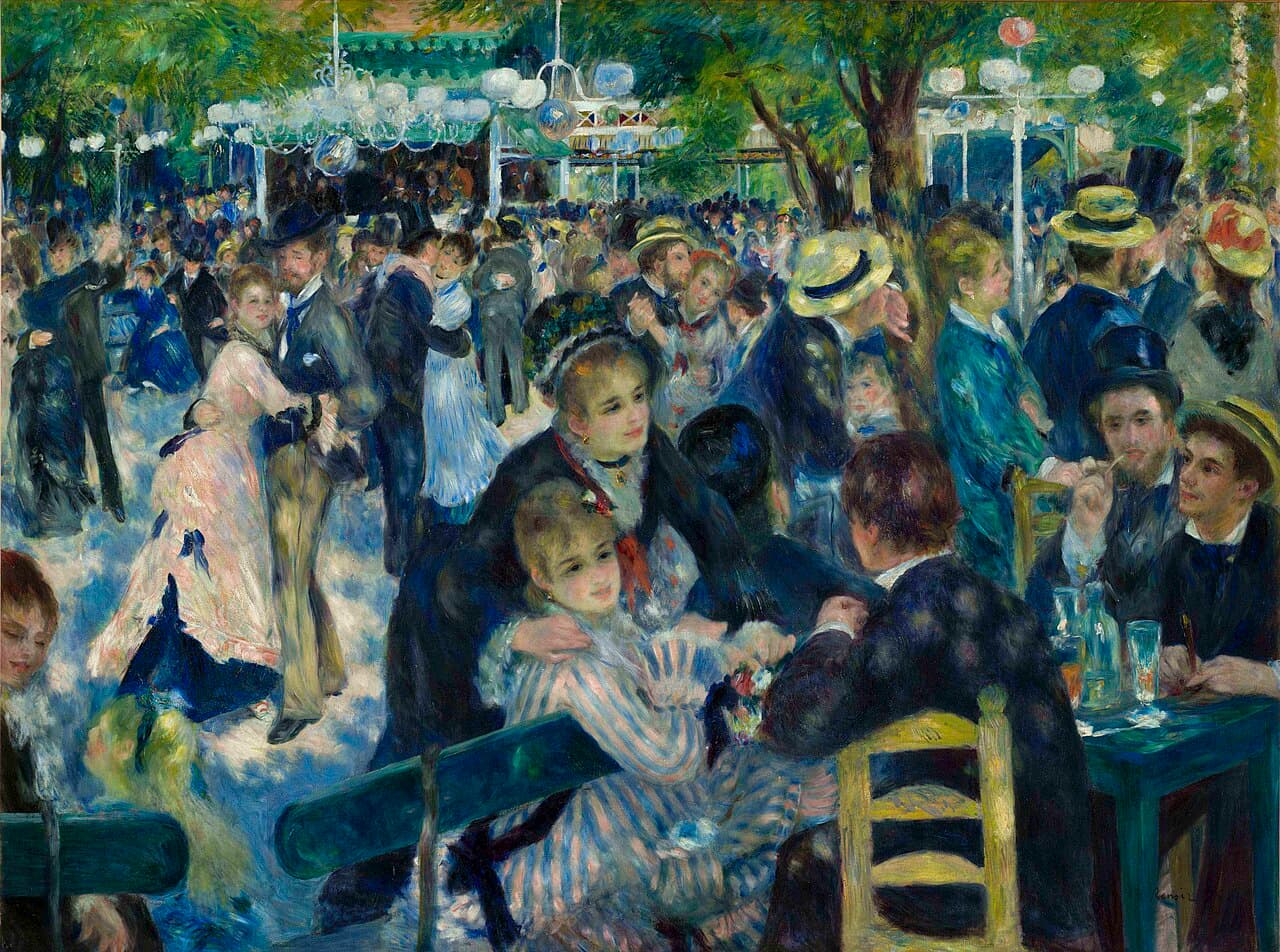
Pierre-Auguste Renoir · 1876
Bal du moulin de la Galette
Sunlight breaking through leaves onto a Sunday-afternoon dance in Montmartre — painted on the spot, with Renoir's own friends standing in as the dancers.
Renoir carried his canvas to the actual outdoor dance hall on Butte Montmartre and painted the crowd as he found it, using friends and models to fill in the faces. The scattered patches of light and shadow across the dancers' clothes are Impressionism's plein-air technique at its most joyful.
How to explore with ELYIO
Orsay's three levels aren't meant to be walked start to finish like a timeline — sculpture fills the ground-floor nave, the Impressionist rooms sit up near the skylights, and Post-Impressionist, Art Nouveau and decorative-arts galleries fill the middle level in between. Most visitors zigzag between levels rather than follow a single line, which is exactly how the building rewards being explored.
Self-guided visits
That non-linear layout is where ELYIO is most useful: instead of hunting for a numbered stop or waiting for a guide to circle back, you point your camera at any work in the curated Orsay catalog — in the nave, on the terraces, or upstairs among the Van Goghs — and get context on the spot, in your own language and at your own pace.
Traditional audio guide vs. ELYIO
Traditional audio guide
Guided groups cluster around the handful of icons everyone recognizes, while entire galleries a few steps away go unremarked.
Wall texts are short, frequently French-only, and easy to miss when a room is crowded.
Audio guides follow a fixed numbered route, which rarely matches the order you actually want to walk the museum in.
With ELYIO
Point your phone at a painting or sculpture in ELYIO's curated Orsay collection to get instant, multilingual context — no waiting for a group to move on.
Wander the nave, the sculpture terraces, and the upper galleries in whatever order suits you; recognition works wherever you stop, not along a fixed path.
Go from Manet to Van Gogh to Degas at your own pace, with plain-language stories instead of academic wall text.
The museum sits on the Left Bank of the Seine, in the 7th arrondissement, directly across the river from the Tuileries Garden and the Louvre — the Musée d'Orsay footbridge connects the two banks. The nearest metro stop is Solférino, with an RER C stop named Musée d'Orsay right beside the building. The structure itself is the former Gare d'Orsay, a Beaux-Arts railway terminus built for the 1900 World's Fair and converted into a museum in the 1980s under architect Gae Aulenti; the original glass-vaulted roof and one of the station's giant gilded clocks are still in place and worth looking up for. Expect a fair amount of walking across uneven floor levels, so comfortable shoes help.
Frequently asked questions
Does ELYIO recognize every artwork in the Musée d'Orsay?
No. ELYIO's camera recognition at Orsay covers a curated selection of the museum's paintings and sculptures — built around its most sought-after works — rather than the full collection of thousands of objects.
Is ELYIO officially affiliated with the Musée d'Orsay?
No. ELYIO is an independent visitor companion app. It is not partnered with, endorsed by, or operated on behalf of the Musée d'Orsay or its parent institution.
Do I need to follow a set route or numbered stops to use ELYIO here?
No. There's no fixed tour route — walk the nave, the sculpture terraces, or the upper galleries in any order, and simply point your camera at a work when you want to know more about it.
What languages does ELYIO support at the Musée d'Orsay?
Recognized works return context in English, French, and Simplified Chinese, so you're not limited to whatever language the nearest wall label happens to be printed in.
Can ELYIO identify sculptures as well as paintings at Orsay?
Yes — the curated catalog includes major sculptures, such as Degas's Little Dancer, alongside paintings, though it does not cover the museum's entire sculpture collection.