The Water Lilies rooms offer almost no wall text — by design, Monet wanted pure immersion, which means visitors often miss the story behind the brushwork.
Downstairs, the Walter-Guillaume collection crowds Cézanne, Renoir, Modigliani and Soutine into intimate rooms with little signage to tell you why each one matters.
What to see
The Orangerie rewards patience more than any museum in Paris. Everything of consequence fits into an hour — which is exactly why it's easy to rush past the details that make it extraordinary.
The Oval Rooms
Monet's eight Water Lilies panels curve around two daylit ovals, arranged to trace an unbroken horizon — sit in the middle of either room and let the panels surround you before moving closer.
The Walter-Guillaume Collection
Dug into the building's lower level during the 2000s renovation, this collection of nearly 150 works assembled by dealer Paul Guillaume traces Impressionism into early Modernism in a single afternoon's walk.
The Cézanne and Renoir Rooms
A dense hang of Cézanne still lifes and Renoir portraits shows two very different responses to the same late-19th-century Paris — one analytical, one sensual.
The Modigliani and Soutine Galleries
Elongated faces and raw, expressive brushwork mark the collection's most modern turn — look for the portraits Paul Guillaume commissioned of his own circle.
Masterpiece stories
Claude Monet · 1920–1926
Water Lilies – The Clouds
A ten-metre stretch of pond, sky and reflection with no horizon line to hold onto.
One of eight monumental panels Monet designed specifically for these oval rooms, painted from his garden at Giverny in the final years of his life and installed here five months after his death.
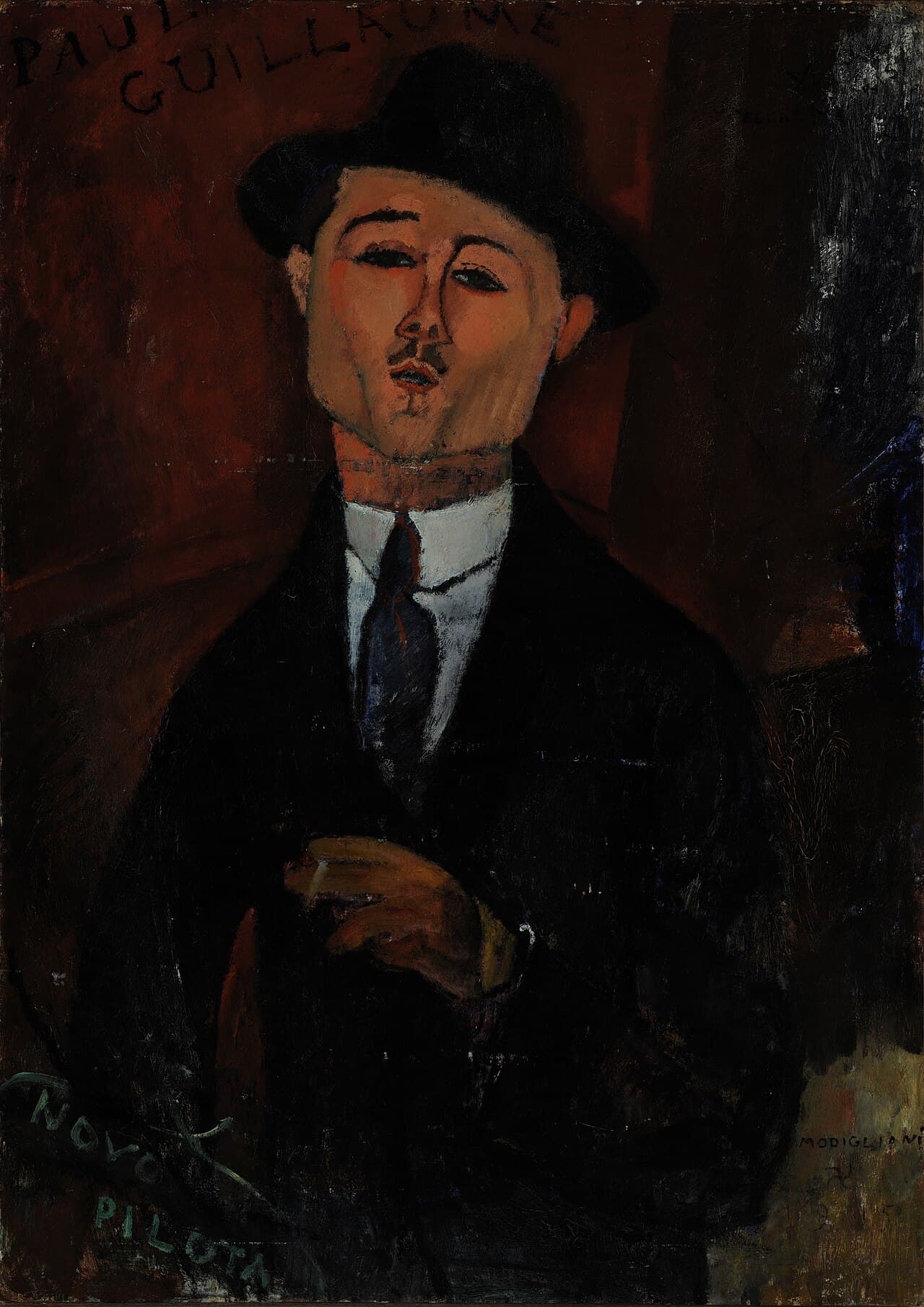
Amedeo Modigliani · 1915
Paul Guillaume, Novo Pilota
The dealer who built this very collection, painted by the artist he championed most.
Modigliani's elongated portrait of Paul Guillaume — inscribed with the nickname 'Novo Pilota,' or 'new pilot' — captures the young dealer who would later assemble the Walter-Guillaume collection now shown downstairs.
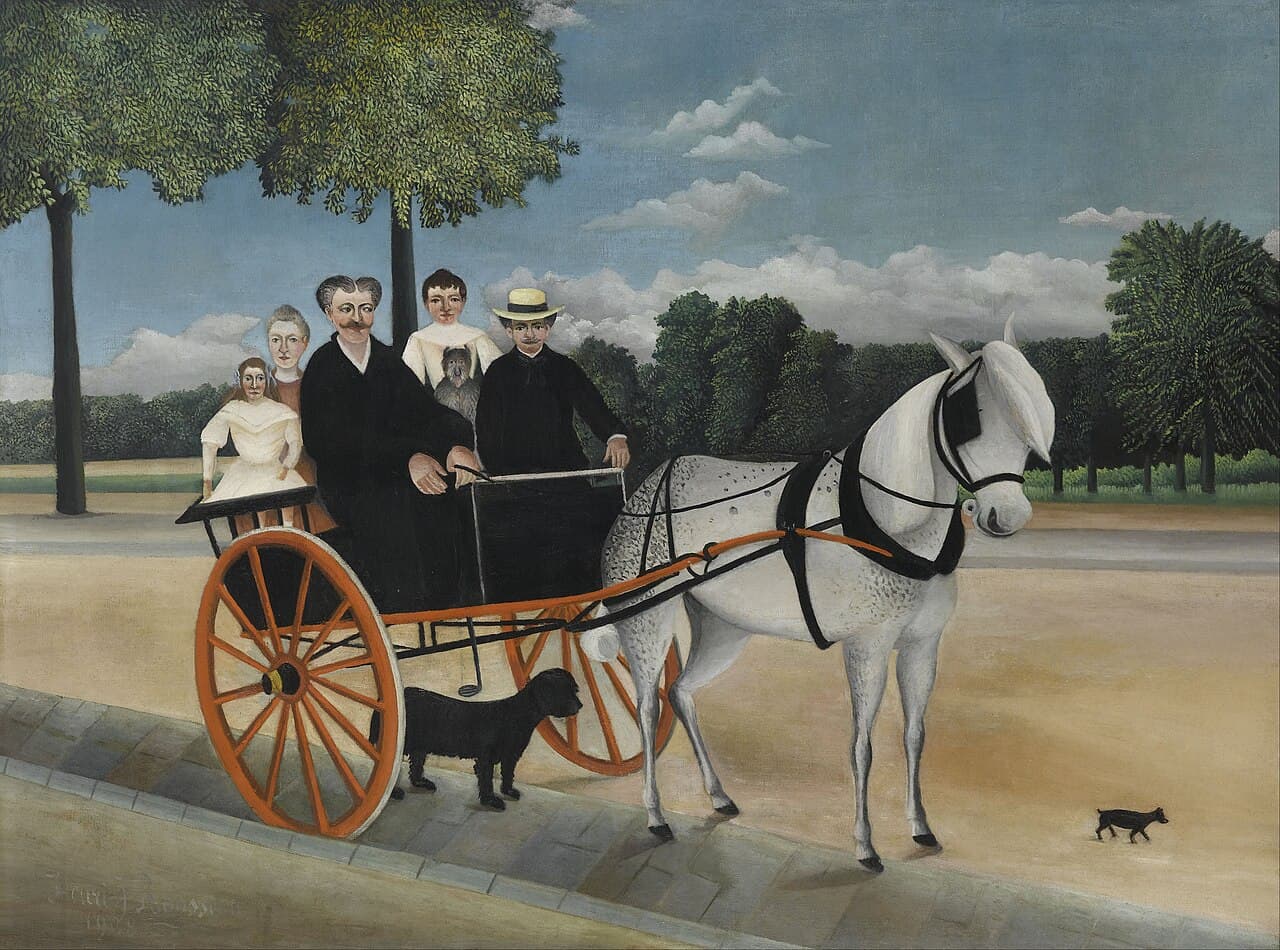
Henri Rousseau · 1908
Father Junier's Cart
A stiff, dreamlike family portrait from an artist who almost never left France.
Rousseau's self-taught, near-naive style — flattened perspective, unwavering stares — sits deliberately among the era's more schooled painters in the Walter-Guillaume rooms.
How to explore with ELYIO
Start upstairs in daylight, when the skylights are at their best, then let the Walter-Guillaume collection unfold in whatever order the rooms suggest — it isn't arranged chronologically, and isn't meant to be rushed.
Self-guided visits
With ELYIO, point your phone at any canvas, portrait or panel and get an instant, reliable read on what you're looking at — no roaming for the one placard that might explain it, no guessing which Renoir this actually is.
Traditional audio guide vs. ELYIO
Traditional audio guide
Scanning the walls for a caption in a sea of nearly identical little frames
A single laminated sheet, at best, trying to cover both oval rooms and 148 works downstairs
Guessing whether a face on the wall is a Modigliani, a Soutine, or a Derain from ten paces away
With ELYIO
Point your camera at any panel or portrait for an immediate, reliable identification
Get the context behind each work — who painted it, when, and why it belongs in this particular room
Move at your own pace through a curated selection of the collection, without waiting on a guide or a group
The Water Lilies rooms depend on natural light from the skylights above, so the mood shifts with the weather and the hour — the panels can look markedly different on a bright morning than on a grey afternoon. The museum sits in the western corner of the Tuileries Garden, an easy walk from the Louvre and the Musée d'Orsay, which makes it a natural stop on a longer Right Bank or riverside itinerary. Because the collection is compact, it suits a slower, second-look visit better than a first sprint through Paris's major museums.
Frequently asked questions
Does ELYIO have an official partnership with the Musée de l'Orangerie?
No. ELYIO is an independent app. We've built a curated recognition catalog for a selection of works at the Orangerie so you can identify what you're looking at with your camera, but we are not affiliated with or endorsed by the museum.
Can ELYIO recognize every painting in the museum?
Not every single work — our catalog covers a curated selection of the Orangerie's most significant pieces, focused on the Water Lilies panels and the core of the Walter-Guillaume collection, with more added over time.
Will ELYIO tell me which route to take through the museum?
There's no fixed route — the Orangerie is small enough to explore freely, and ELYIO is built to identify whatever you point your camera at, wherever you happen to be standing.
Do I need a ticket from ELYIO to visit the museum?
No. ELYIO isn't a ticketing service. Buy your museum entry directly from the Musée de l'Orangerie, then use ELYIO once you're inside to identify and understand the works.
Does ELYIO work without an internet connection inside the museum?
ELYIO needs a data connection to recognize artworks and pull up context, so it's worth checking your signal or data plan before you visit.